IFCA will give its name to research support grants awarded in conjunction with Women for Africa Foundation
UC Editorial, 21th May 2021
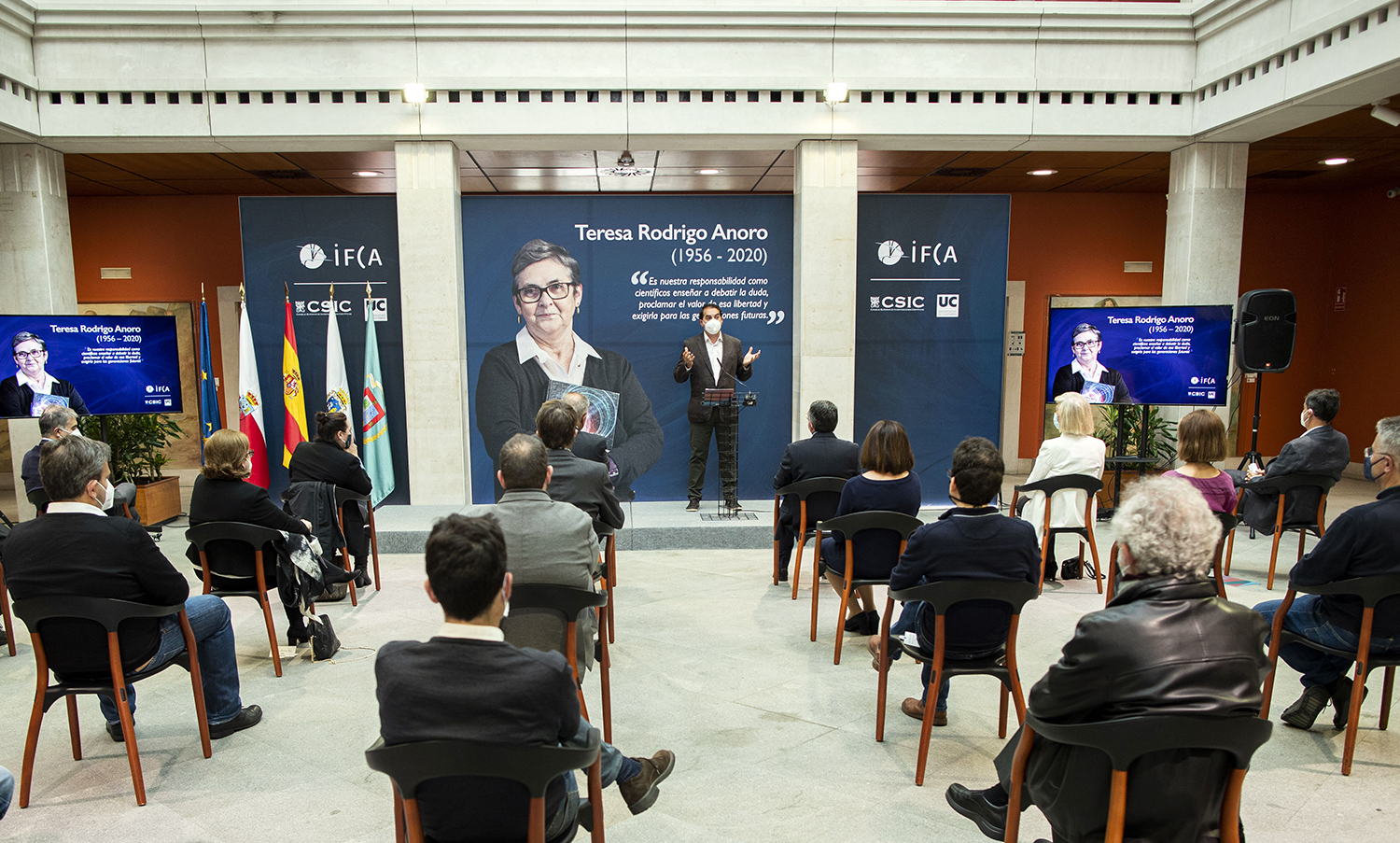
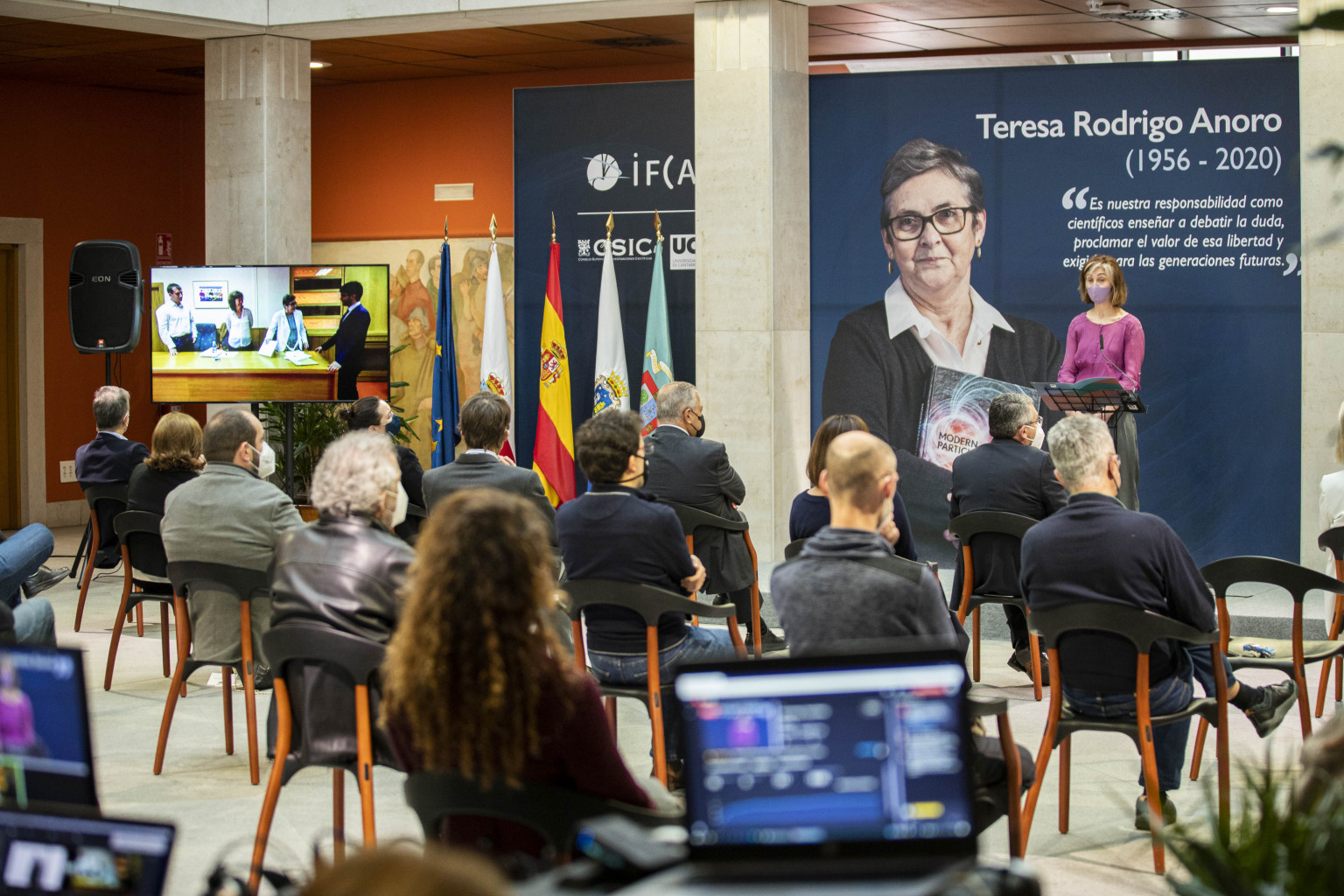
This afternoon, the auditorium of University of Cantabria (UC) hosted a tribute to
Teresa Rodrigo Anoro, Professor of Atomic Physics and researcher at the Instituto de Física of Cantabria (a joint UC-CSIC centre). With limited capacity and sanitary measures required by current situation, the event was presided over by the Vice-Rector for Research and Science Policy of University of Cantabria,
Luigi dell'Olio, and the Vice-President for Scientific and Technical Research of the Spanish National Research Council (CSIC),
Jesús Marco de Lucas.
The tribute, which could be followed in streaming thanks to its live broadcast, was attended by academic authorities and different regional and local administrations, headed by the President of Parliament of Cantabria,
Joaquín Gómez; the Regional Minister of Education and Vocational Training of the Government of Cantabria,
Marina Lombó; the Councillor for Youth, Education and Health of Santander City Council,
Noemí Méndez; the Vice-Rector for Academic Organisation and Teaching Staff,
Ernesto Anabitarte; the Vice-Rector for Internationalisation and Global Commitment,
Matxalen Llosa; and the Dean of the Faculty of Science,
Francisco Matorras.
The Vice Rector
Luigi dell'Olio closed the session by highlighting importance for society of
"good teachers" and
"scientific and technological development", both important aspects of the honoree.
"Teresa Rodrigo was a pioneer in her field, a source of inspiration for her students, and through them she continues to pass on her talent to future researchers".
He also defined her as
"the architect of great team that makes up the IFCA", making
"our University a world reference" in particle physics.
"It is up to us to take advantage of her legacy and capitalise on her achievements so that they are not forgotten and so that new generations continue to enrich the world of science", said Dell'Olio.
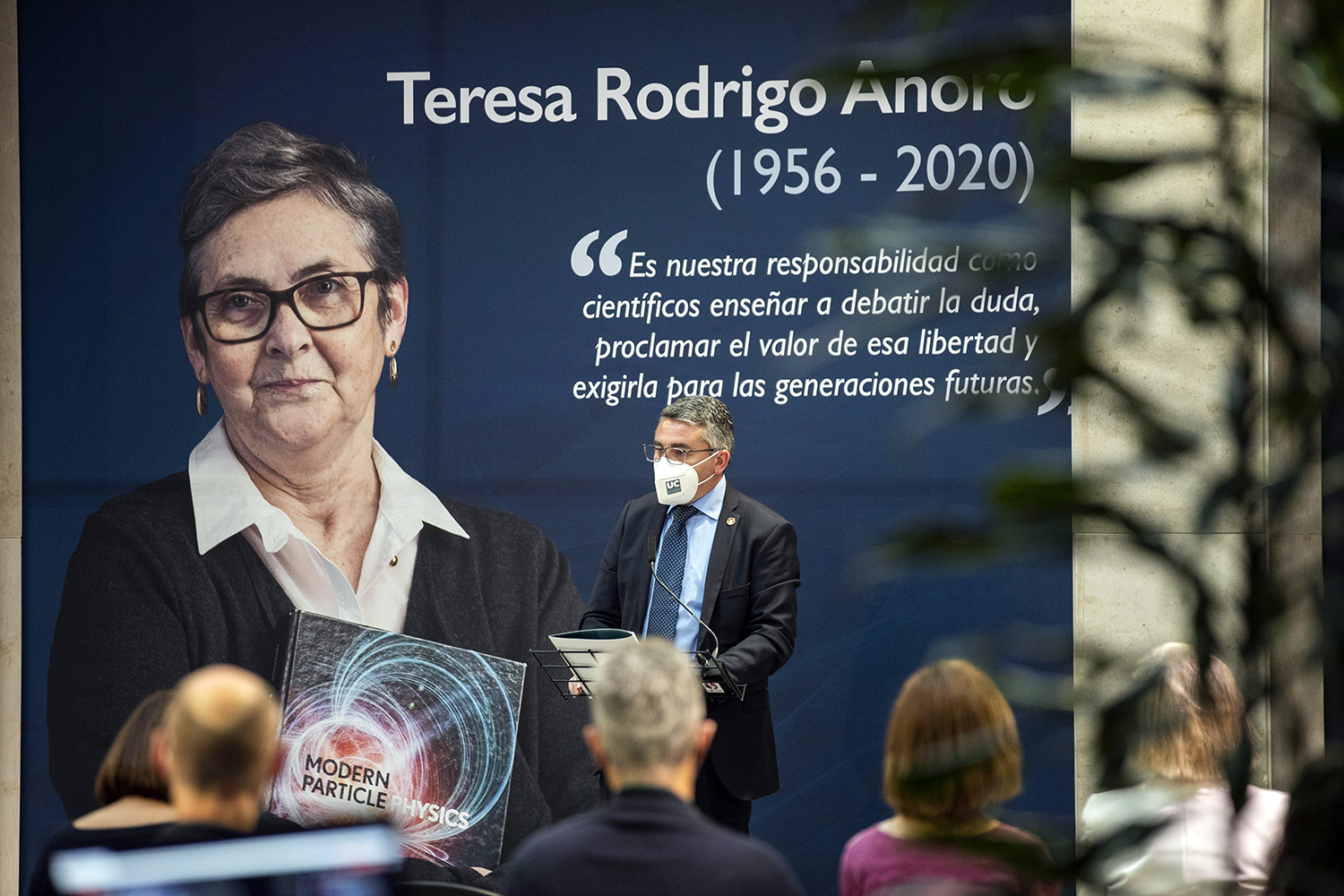
The event was conducted by the Director of the Instituto de Física de Cantabria,
José Manuel Gutiérrez Llorente, who highlighted
"two words that I would frame" about Teresa Rodrigo:
"generosity" and
"humility". The former member of IFCA's management team led by Rodrigo, under which this centre achieved the María de Maeztu seal of excellence, referred to her
"tenacity, strength and leadership", as well as the
"vision she had on scientific policy to set realistic objectives". "She left an indelible mark on everyone", said Gutiérrez, announcing that the Institute's boardroom, "the most luminous", will be named after Teresa Rodrigo Anoro, and scholarships that IFCA, together with the Women for Africa Foundation, is offering for the Master's degree in Particle and Cosmos Physics.
For his part, the Vice-president for Scientific and Technical Research at the CSIC,
Jesús Marco, stressed how Teresa Rodrigo
"fulfilled all the necessary requirements" to manage an international collaboration as complex as CMS: confidence, vision, emotional intelligence, leadership...
"She taught us how important this task was and how to do it", said Marco.
"I have seen how Teresa created a team and made it evolve until it reached the goal it set itself, to achieve the best results", he added.
Tribute also included a speech by one of Teresa's sisters,
Pilar Rodrigo, who began her emotional speech by saying, on behalf of her family, that
"whenever we think of Teresa, which is always, we remember her smile". She also highlighted
"her sense of humour, calm and restlessness, solidarity, sense of justice and her strong but at the same time calm character".
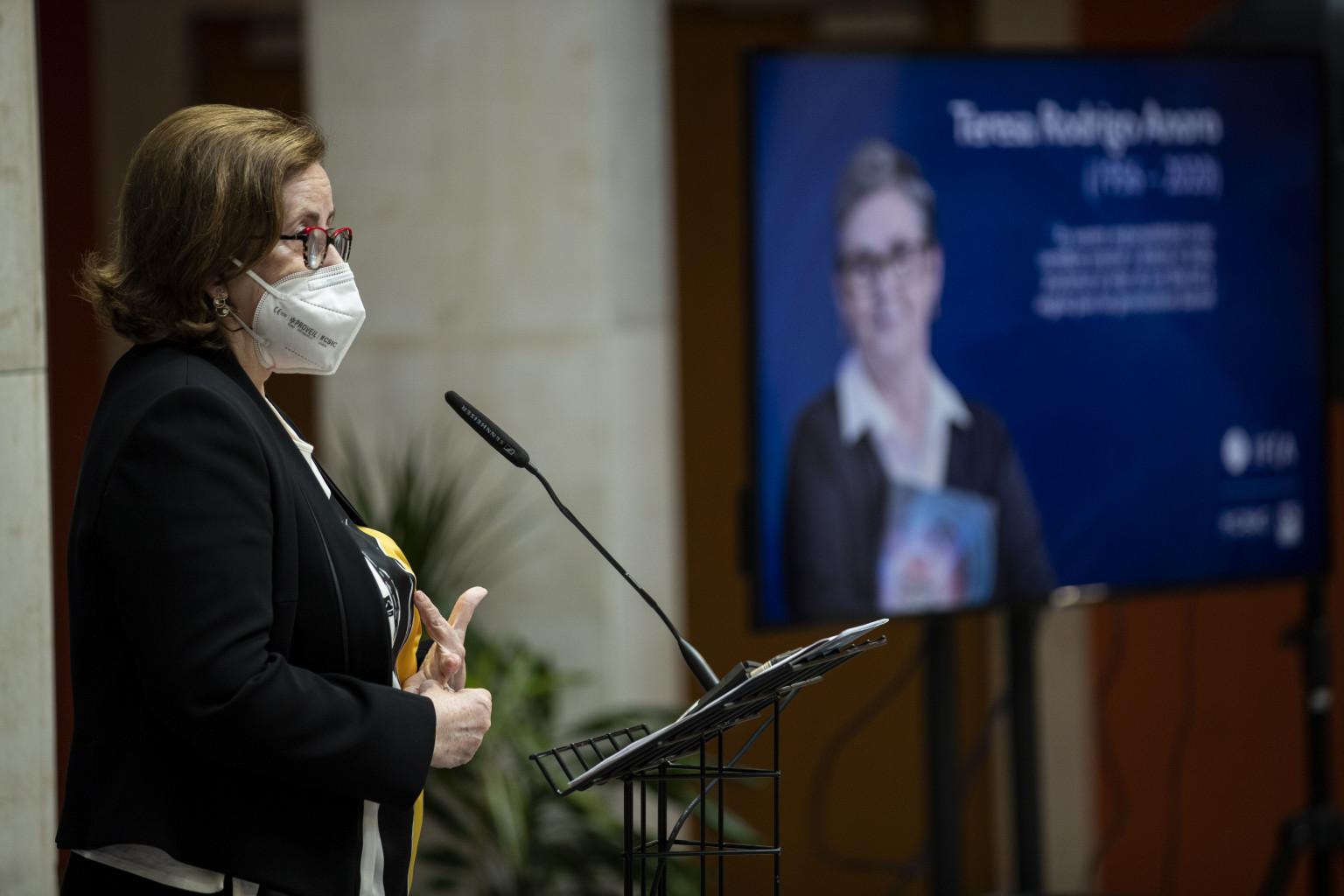
Several videos were shown during the event. Firstly was a "laudatio", reviewing Teresa Rodrigo's brilliant professional career, both in her facet as a researcher, teacher and scientific disseminator, as well as in the promotion of equality.
The second audiovisual piece included testimonies from friends and colleagues of the honoree, highlighting both her professional worth and her personal values. María Josefa Yzuel, Alberto Casas, Antonio Pich, Antonio Molinero, Manuel Aguilar, María Isabel Josa, Vaia Papadimitriou, Alberto Ruiz Jimeno, Mary Cruz Fouz, Teresa Barriuso, Saturnino Marcos, Guillelmo Gómez-Ceballos, Begoña de la Cruz, the High Energy Experimental Physics Group of the University of Oviedo, Marcos Cerrada, Francisca Muñoz, Cristina Fernández, Lara Lloret, Pablo Martínez, Francisca García and Montserrat Cabré.
A third video was also shown,
made as a class project by sixth-form students at the Antònia Simó Arnó Public School in Almacelles (Lérida), where she studied. In this piece they have remembered her figure and career.
Other speeches
Also speaking at event was Carmen García (IFIC, CSIC), who highlighted the pioneering role of Teresa Rodrigo, her impact on Spanish science and scientific community. She reviewed her research career, linked to major discoveries in recent decades such as hadron accelerators, top quark and the Higgs boson.
For her part, Rocío Vilar (IFCA, CSIC-UC) spoke about Teresa Rodrigo's students, the mark she left on them, her ability as a teacher and how she opened the doors of some international centres, such as CERN, to many Spanish researchers.
In his speech, Jacobo Konigsberg, professor at the University of Florida, addressed qualities and skills of Teresa Rodrigo in her work as a scientist and researcher, her tenacity, effort, leadership skills and her global vision, and he also spoke about his personal experiences with her which had the greatest impact on him.
Finally, Pilar López (ICMM, CSIC) presented the figure of Teresa Rodrigo as an example for Spanish scientists and how she was a pioneer in her field as a woman, with few resources and no previous support. She also spoke of her struggle to highlight the work and role of women in science and how she has served as a reference for new generations.
Teresa Rodrigo
Died in 2020, Teresa Rodrigo Anoro (Lleida, 1956) was the first Spaniard to work in leading experiments in the field of elementary particles and in large facilities where they are carried out, such as the European Organization for Nuclear Research (CERN), where she led one of the teams that collaborated in the discovery of the Higgs boson, considered one of the greatest scientific achievements of last 50 years. The scientist paved the way for Spanish physicists in these major international facilities.
A tireless fighter and staunch defender of role of women in scientific world, Teresa Rodrigo was a professor of Atomic Physics at the University of Cantabria since 1994 and a researcher at the Spanish National Research Council (CSIC). In 2016 she took over direction of the Instituto de Física of Cantabria, where she was a researcher and head of High Energy Physics and Instrumentation Group. Her work was mainly developed in hadron collider experiments, where she carried out projects ranging from physical analysis to construction of particle detectors.
Co-author of an extensive list of scientific publications and books, Teresa Rodrigo is Silver Medalist of the University of Cantabria. She was also named "honoris causa" doctor by the Universidsad Internacional Menéndez Pelay (UIMP) and received the 1st Julio Peláez Prize for Pioneers in Physics, Chemistry and Mathematics, among other awards.
Since 1994 she has been a member of the CMS (Compact Muon Solenoid) experiment at the Large Hadron Collider LHC, world's largest particle accelerator at CERN. She led the group of more than 30 researchers from IFCA and University of Cantabria involved in this experiment, both in its design, construction, installation and operation of alignment system and in preparation of a Tier-2 data processing centre and, now, in analysis of data obtained at LHC.
In 2010 she was appointed president of its International Collaboration Council, in which institutions from more than 40 countries participate, and since 2012 she has been a member of CERN's Science Policy Committee, being the first Spanish physicist to form part of this body and one of the few people of this nationality to have advised the world's largest particle physics laboratory on scientific matters.
In addition to CERN, she worked at the Fermi National Accelerator Laboratory - FERMILAB, of US Department of Energy, the most important particle physics laboratory in United States. His work on Collider Detector - CDF experiment, which led to discovery of top quark in 1995, a milestone in field of particle physics, is particularly noteworthy.